
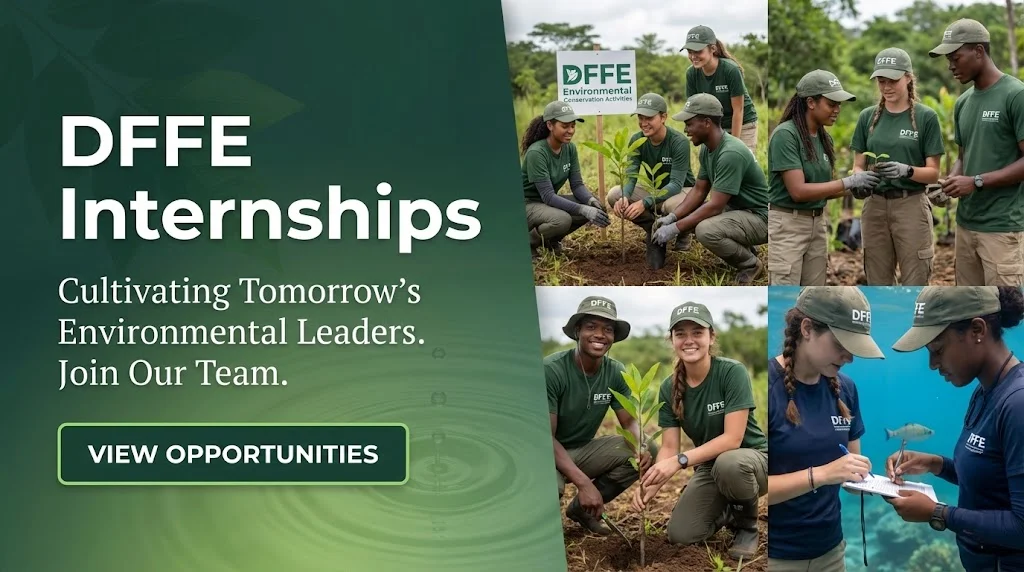
South Africa has a massive coastline and huge protected forests. The national government cannot manage all this natural space with just their permanent staff. To get extra help on the ground, the department uses DFFE Internships to bring young science graduates straight into active conservation work.
Working for the Department of Forestry, Fisheries and the Environment is very practical. If you studied marine biology, you might spend your year on a research ship in Cape Town counting fish. If you studied forestry, they could send you to Mpumalanga to track where people are chopping down trees illegally.
But not every job is outside in nature. If you join the air quality or waste management teams, your daily work is mostly about numbers. You will read chemical pollution reports from big factories to make sure they are not breaking the National Environmental Management Act (NEMA).
Spending a year inside the government teaches you exactly how environmental laws actually work in real life. Once you know how to process state permits and check compliance, private environmental consulting companies will want to hire you because you understand the government system.
Because this is a national government department, the application process is very strict about paperwork. If you apply for a science job but forget to attach a certified copy of your Matric certificate or ID, the HR team will just reject your application. They do not give you a second chance to fix your documents.
Advertisements
Our Honest Take: Public Conservation vs. Private Consulting?
Our Analysis: Working for a private environmental consulting firm usually means helping mining or construction companies get their legal permits approved quickly. Working for the DFFE means you are the regulator on the other side of the table. You get unmatched access to national parks and state research vessels, but the state bureaucracy moves very slowly. Procuring new field equipment or getting approval to publish a research paper can take months of paperwork.
Expert Pro Tip: “Match the Province to the Branch.” The department is heavily decentralized. Do not apply for a Fisheries internship if you live in Gauteng; those marine roles are strictly based in the Western and Eastern Cape. Conversely, heavy Air Quality monitoring roles are usually concentrated around the industrial hubs in Gauteng and Mpumalanga.
Job Overview: Stipends & Allowances (2026 Estimates)
| Qualification Level | Est. Monthly Stipend (ZAR) | Programme Type |
| Honours / Master’s (NQF 8/9) | R8,000 – R10,000 | Graduate Scientist |
| BSc Degree (NQF 7) | R6,500 – R8,000 | Environmental Trainee |
| National Diploma (NQF 6) | R5,500 – R7,000 | Field Assistant |
| Matric / NCV (NQF 4) | R4,000 – R5,000 | Forestry Learnership |
Advertisements
Which Environmental Branches Take Interns? (2026 Breakdown)
The department is highly specialized, divided into distinct “Branches” that handle different aspects of national law. You must target the branch that matches your specific science or legal degree:
1. Oceans & Coasts (Fisheries Management)
- Target Audience: Graduates holding BSc Degrees in Marine Biology, Oceanography, or Ichthyology.
- The Daily Grind: Monitoring the oceans. Stationed primarily in coastal cities, you will assist state scientists in tracking commercial fishing quotas, analyzing seawater temperatures for climate change data, and physically inspecting fishing vessels at the docks to prevent illegal poaching.
2. Biodiversity & Conservation
- Target Audience: Graduates with Degrees in Zoology, Botany, Ecology, or Wildlife Management.
- The Daily Grind: Protecting the land. You will often work closely with SANParks. Trainees help update national databases on endangered plant species, process permits for the legal hunting or transport of wildlife, and assist in drafting management plans for newly declared protected nature reserves.
3. Climate Change & Air Quality
- Target Audience: Graduates holding qualifications in Environmental Science, Chemistry, or Environmental Law.
- The Daily Grind: Enforcing the law. You will review Annual Emission Reports submitted by massive coal power stations or private manufacturing plants. You help ensure these companies are keeping their carbon and chemical pollution within strict legal limits, and assist senior compliance officers during physical factory inspections.
The Reality of Working in State Environmental Science
Having the national regulatory authority on your CV is incredibly valuable for your scientific career, but the daily reality of the department is a mix of fieldwork and heavy administration:
- The Fieldwork vs. Desk Work Split:
Many graduates assume they will spend 12 months outdoors saving rhinos or planting trees. In reality, modern environmental management is heavily reliant on data. You will likely spend 70% of your time at a computer, capturing field data into Excel, writing compliance reports, and processing public permit applications.
- Strict Regulatory Protocols:
You are not just conducting fun science experiments; you are gathering data that could be used in a court of law against illegal poachers or polluting factories. Every water sample you take or emission reading you record must follow strict “chain of custody” protocols so the data remains legally valid.
- Navigating State Procurement:
If you are stationed at a rural forestry office or a remote coastal research station, getting supplies can be frustrating. Because it is a government department, buying a simple replacement part for a broken water testing kit requires submitting three formal quotes and waiting for central finance approval.
Featured “Hot” Programme: Air Quality Compliance Trainee
The Department of Forestry, Fisheries and the Environment (DFFE) is seeking analytical Environmental Science graduates to join our Climate Change and Air Quality branch. This structured public sector internship provides hands-on experience in enforcing national emission standards, analyzing industrial chemical data, and ensuring private corporations comply strictly with the National Environmental Management Act (NEMA).
- Estimated Stipend: R6,500 – R8,000 per month (24-month contract).
- Location: Environment House (Pretoria) or Regional Industrial Hubs (Gauteng/Mpumalanga).
Requirements:
- A completed BSc Degree or National Diploma in Environmental Science, Chemistry, or Chemical Engineering.
- A strong theoretical understanding of the National Environmental Management: Air Quality Act (NEMAQA).
- High proficiency in data analysis and MS Excel.
- Must be a South African citizen with a clean criminal record.
How to Apply Correctly? (The State Process)
Because DFFE is a national government department, applying for a job here is very different from applying to a private company. Sending a normal email with your CV will not work. You have to follow the standard public service rules.
The Mandatory Z83 Form
Every government job requires an official Z83 application form. You can download the newest version directly from the official DPSA website or pick one up at any state office. The most important part is the ‘Reference Number’. You have to write down the exact reference code for the specific internship you want. If you leave this blank or get the number wrong, the HR team will not know which branch to send your CV to.
Waiting for the Annual Circular
The department does not hire interns every month. They usually put out one big document called an ‘Internship Circular’ once a year, normally around October or November. This PDF is posted on the Official DFFE Careers Page and lists every available job across all the provinces. You have to read it carefully to find the correct postal address or email for the specific province you want to join.
Strict Paperwork and No Staples
Government HR is very strict about documents. You must include your Z83, a short CV, and certified copies of your ID and degree. The police stamp on your copies must not be older than six months. Also, a very practical tip: do not staple your pages together. The department receives thousands of applications and uses fast scanning machines. Staples just slow down their work and can get your pages torn.
Thabo Mandla is the lead Career Guide Expert at DurbanTalent.com. With over 10 years of practical experience in South African recruitment, he specializes in connecting professionals with top employers in Aviation, Finance, and Hospitality. Thabo combines his background in Human Resources with direct insights from local hiring managers to provide job seekers with accurate, actionable, and reliable career advice. He is passionate about helping candidates navigate the Durban job market and achieve their professional goals.
Advertisements