
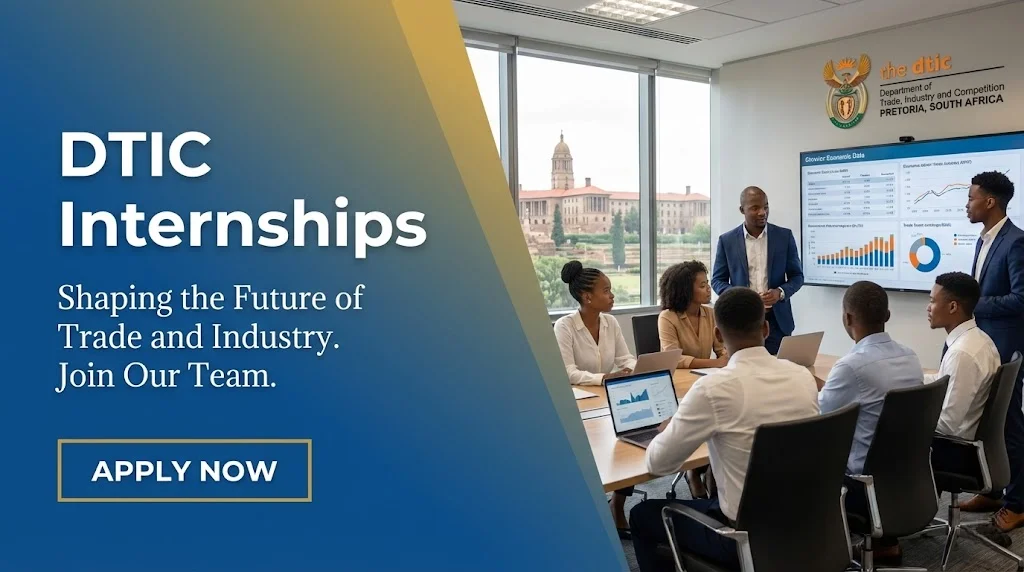
The Department of Trade, Industry and Competition is the central engine room of South Africa’s economic policy. They dictate import tariffs, manage the AfCFTA (African Continental Free Trade Area) agreements, and control massive industrial funding grants. Because their legal and economic mandate is so broad, the department relies heavily on the annual DTIC Internships to staff their highly specialized research directorates.
Most trainees are stationed directly at the main dtic Campus in Sunnyside, Pretoria. Graduates are immediately assigned to specific sector desks—like the automotive, textile, or green energy branches. You will spend your 24-month contract analyzing complex industry data, tracking foreign direct investment, and reviewing funding proposals submitted by local manufacturers.
It is a highly academic and reading-intensive environment. You must be comfortable digging through dense legislative gazettes and corporate financial compliance reports before drafting policy briefs for senior economists. The work moves at the pace of government bureaucracy, meaning accuracy and strict adherence to DPSA protocols matter far more than speed.
Because you will be handling sensitive, market-moving data and corporate trade secrets, the HR screening is notoriously strict. Before you can officially sign your developmental contract, the State Security Agency (SSA) conducts a comprehensive background and financial vetting process to ensure absolute confidentiality.
Our Honest Take: DTIC vs. Private Financial Firms?
Our Analysis: Starting your career at a private investment bank pays much better, but working at the DTIC gives you the “policymaker’s perspective.” You get to see exactly how the government decides which industries get state funding and how import tariffs are calculated. Private firms actively headhunt former DTIC interns because they understand the state’s legal red tape better than anyone else.
Expert Pro Tip: “The Vetting Reality.” The department deals with highly sensitive national trade secrets and market-moving data. Before you are fully absorbed into a division like Export Controls, the State Security Agency (SSA) will conduct a deep background check on you. A completely clean criminal record and uncompromised financial history are non-negotiable.
Job Overview: Stipends & Allowances (2026 Estimates)
| Qualification Level | Est. Monthly Stipend (ZAR) | Programme Type |
| Master’s / Honours (NQF 8) | R8,500 – R9,500 | Specialist Grad Intern |
| Bachelor’s Degree (NQF 7) | R6,500 – R7,500 | Graduate Intern |
| National Diploma (NQF 6) | R5,500 – R6,500 | Student Intern |
| Admin / TVET (NQF 5) | R4,500 – R5,500 | WIL Placement |
Which Directorates Take Interns? (2026 Breakdown)
The department is highly specialized, and you cannot apply blindly. You must align your application with the specific branch that matches your university major:
1. International Trade & Economic Development
- Target Audience: Graduates holding Degrees in Economics, International Relations, or Econometrics.
- The Daily Grind: Analyzing the global market. You will assist senior economists in researching import/export tariffs, drafting briefing notes on African Continental Free Trade Area (AfCFTA) negotiations, and tracking foreign direct investment data.
2. Consumer & Corporate Regulation
- Target Audience: Graduates with a LLB (Law) or BCom in Business Management.
- The Daily Grind: Enforcing the rules. You will work alongside legal teams to review national gambling policies, analyze reports from the National Credit Regulator, and assist in drafting amendments to the Companies Act to ensure fair local business practices.
3. Industrial Financing & Enterprise Development
- Target Audience: BCom graduates in Finance, Accounting, or Supply Chain Management.
- The Daily Grind: Moving state funds. You will help process applications from local manufacturers seeking state grants, audit the financial compliance of companies receiving government incentives, and manage basic procurement paperwork.
The Reality of Working at the DTIC
Working inside a core national economic department is a massive achievement, but the daily environment is very different from the fast-paced private sector:
- The Heavy Reading Load:
If you do not like reading long, complex legal and economic documents, this is not the place for you. You will spend hours pouring over legislative gazettes, policy drafts, and dense financial reports before writing summaries for your branch manager.
- Strict State Bureaucracy:
Things move slowly in government. A simple policy proposal or an approval for a local business grant might require signatures from five different directors. You have to be patient and highly organized, ensuring that every single document you process follows exact state compliance rules.
- Total Confidentiality:
Because you are dealing with state funding and potential trade embargoes, you cannot discuss your daily work on social media. Leaking internal market data before the Minister officially announces it is a severe criminal offense.
Featured “Hot” Programme: Economic Research Graduate Intern
The department relies heavily on fresh research graduates to pull the latest statistical data on local manufacturing outputs and global inflation trends.
- Estimated Stipend: R6,500 – R8,500 per month (24-month contract).
- Location: dtic Campus, Sunnyside, Pretoria (Gauteng).
Requirements:
- A completed Degree (NQF 7 or higher) in Economics, Statistics, or Public Policy.
- Strong proficiency in data analysis and MS Excel.
- Must be an unemployed South African citizen between 18 and 35 years old.
- Exceptional academic writing and research skills.
How to Apply Correctly? (The Government Pipeline)
The DTIC strictly follows national DPSA recruitment protocols. Direct emails to branch managers or LinkedIn messages are completely ignored. Here is the actual submission process:
The Mandatory Z83 Rule
You cannot apply with just a CV. You must submit the newly updated Z83 Government Application Form. Using an outdated form or leaving the specific circular reference number blank results in instant disqualification.
Official Portals & Certification Limits
Intakes are always published on the official DTIC careers page and national DPSA circulars. When submitting your PDF application, check your police stamps. If your certified ID or degree copies are older than 6 months, the HR system will automatically reject you.
The Physical Drop-off Advantage
If you live in Gauteng, bypassing the government email servers is your safest bet. Hand-deliver your printed Z83, CV, and certified documents directly into the application box at the dtic Campus (77 Meintjies Street, Sunnyside). This guarantees your paperwork doesn’t get lost in a full inbox.”
Thabo Mandla is the lead Career Guide Expert at DurbanTalent.com. With over 10 years of practical experience in South African recruitment, he specializes in connecting professionals with top employers in Aviation, Finance, and Hospitality. Thabo combines his background in Human Resources with direct insights from local hiring managers to provide job seekers with accurate, actionable, and reliable career advice. He is passionate about helping candidates navigate the Durban job market and achieve their professional goals.