
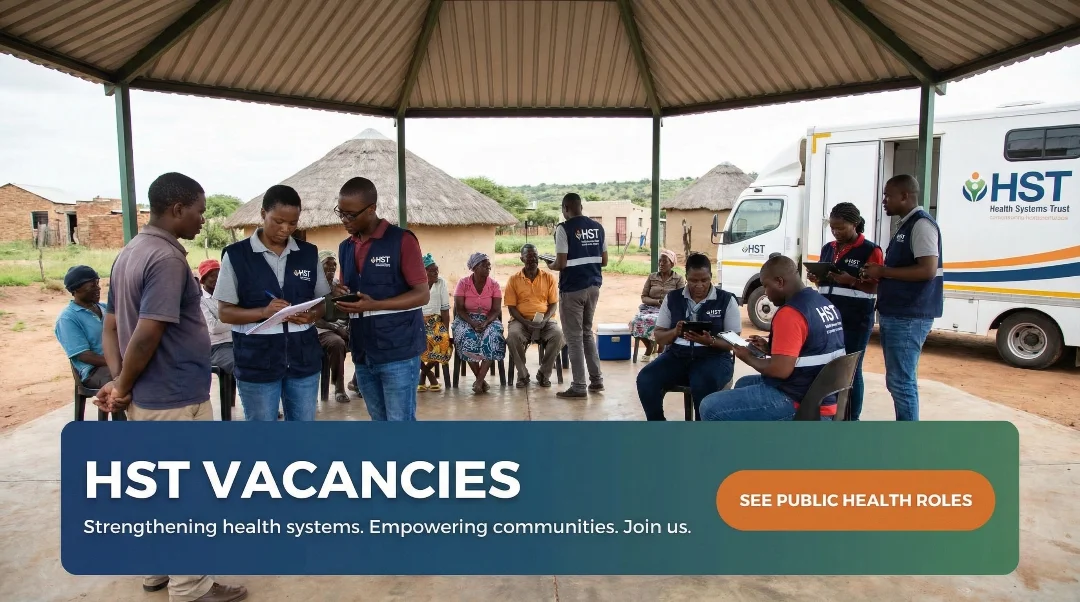
If you want to drive tangible, grassroots change within the South African public healthcare system, applying for the latest HST Vacancies is a phenomenal career choice. The Health Systems Trust (HST) is a highly respected non-profit organization dedicated to strengthening the national health system.
For over three decades, HST has partnered directly with the national Department of Health to combat the country’s heaviest disease burdens. Their operations are heavily focused on HIV/AIDS, Tuberculosis (TB), and sexual reproductive health interventions in deeply marginalized districts.
Because their mandate is vast—covering both physical clinical care and complex health systems research—their recruitment needs are continuous. They are constantly searching for dedicated NIMART nurses to initiate antiretroviral therapy, precise data capturers to track patient progress, and community linkage officers to trace treatment defaulters.
Securing a role at HST means entering a highly specialized, donor-funded NGO environment. Employees benefit from highly competitive clinical salaries, travel allowances for field workers, flexible working schedules, and the profound opportunity to impact public health policy on a national scale.
Let’s review the realistic earning potential for clinical and data staff, the specific public health jobs South Africa heavily relies on, and the correct digital steps to submit your CV.
Our Honest Take: HST vs. General State Clinics?
Our Analysis: Working directly for a government clinic means dealing with every imaginable medical issue. Working for the Health Systems Trust is vertical and highly focused. Your role will be tied directly to a specific donor grant (e.g., reaching UNAIDS 95-95-95 targets). The administrative and data reporting pressure here is significantly higher than in state clinics because international donors demand strict proof of impact. The pay is excellent, but your job security is ultimately tied to the lifespan of the specific grant you are hired under.
Expert Pro Tip: “The NIMART & DHIS Keyword.” If you are applying for a clinical nursing role, your CV must explicitly highlight your NIMART (Nurse-Initiated Management of Anti-Retroviral Treatment) certification. If you are applying for a data or administrative role, proving your speed and accuracy on the national TIER.Net and DHIS (District Health Information System) databases is the absolute fastest way to get shortlisted.
Job Overview: Salary & Benefits (2026 Estimates)
| Role | Est. Monthly Salary (ZAR) | Category |
| District Health Manager | R55,000 – R80,000 | NGO Leadership |
| M&E Data Analyst | R35,000 – R55,000 | Program Impact |
| Clinical Nurse Practitioner | R30,000 – R45,000 | Direct Care |
| Pharmacist Assistant | R15,000 – R22,000 | Dispensary |
| Data Capturer (TIER.Net) | R12,000 – R16,000 | Admin Support |
| Linkage / Tracing Officer | R8,500 – R13,000 | Field Support |
Available Job Positions (2026 Breakdown)
Because HST runs physical clinical interventions alongside complex data-tracking programs, their recruitment circulars are divided into three distinct operational streams:
1. Direct Clinical Services & Field Interventions
- Roles: NIMART Nurses, Medical Officers, Phlebotomists, Lay Counselors.
- The Job: Testing and treating. You will conduct rapid HIV/TB screening in community setups, initiate newly diagnosed patients onto ARVs, and provide Pre-Exposure Prophylaxis (PrEP) to high-risk youth populations.
- Requirements: Relevant Diplomas or Degrees in Nursing. Active SANC registration is strictly required. NIMART certification is mandatory for Professional Nurses initiating treatment.
2. Data Management & Health Systems (M&E)
- Roles: Data Capturers, M&E Officers, Health Informatics Specialists, Epidemiologists.
- The Job: Tracking the numbers. You will capture hundreds of patient files daily into TIER.Net, analyze district-level viral load suppression rates, and prepare massive compliance reports to secure continued international funding.
- Requirements: Degrees in Public Health or Statistics for M&E roles. Data capturers require extreme typing accuracy and specific TIER.Net/WebDHIS experience.
3. Community Linkage & Tracing
- Roles: Linkage to Care Officers, Community Health Workers (CHWs), Tracing Facilitators.
- The Job: Keeping patients in the system. You will physically travel into deep rural communities to locate patients who have defaulted on their ARV treatment, counsel them on adherence, and safely escort them back to their primary clinic.
- Requirements: Deep knowledge of local community dynamics and fluency in local languages. A valid driver’s license is essential for extensive rural driving.
The Reality of Working in a Public Health NGO
- Heavy Field Travel:
HST operates extensively where the state struggles—deep in rural or marginalized districts (like uMgungundlovu or eThekwini). If you are a Linkage Officer or a Mobile Nurse, you will spend your days driving on terrible dirt roads, exposed to the elements, actively searching for patients.
- Constant Donor Audits:
Because HST utilizes international funding (like USAID or PEPFAR), their auditing processes are ruthless. Every patient tested, every pill dispensed, and every kilometer driven must be perfectly documented. Data capturers face massive pressure at the end of every reporting quarter.
- Contract Uncertainty:
NGO jobs are mostly grant-funded. When a specific project (e.g., a 3-year USAID grant) concludes, your employment contract may also end if the NGO does not secure a renewal or new funding. You must remain highly adaptable in your career planning.
Featured “Hot Job”: Clinical Nurse Practitioner – NIMART
To meet ambitious global decentralized HIV treatment targets, HST relies heavily on highly skilled, NIMART-trained Professional Nurses.
- Estimated Salary: R30,000 – R45,000 per month (plus travel allowances).
- Location: Various DOH Clinics (e.g., KZN, Eastern Cape).
Requirements:
- A recognized Diploma or Degree in General Nursing.
- Active, unexpired registration with the South African Nursing Council (SANC).
- Formal, certified completion of NIMART training.
- Minimum 3 years of clinical experience in primary healthcare, specifically focusing on HIV/TB management.
- A valid Code 8 driver’s license (essential for moving between satellite clinics).
How to Apply Correctly? (Multiple Channels)
HST is a highly structured organization, and their application process is entirely digital. Physical CVs dropped at state clinics are generally ignored.
Method 1: The Official HST Digital Portal
This is the primary route for all clinical, data, and administrative roles.
- Step 1: Visit their official HST careers page.
- Step 2: Browse the open vacancies. Ensure you check the specific district requirements, as jobs are highly localized.
- Step 3: Click the application link provided in the advert, which will route you to their internal Applicant Tracking System (ATS).
- Step 4: Upload your CV in PDF format.
Crucial: If you are a nurse or pharmacist, your CV must be accompanied by a clear copy of your active SANC/SAPC registration and NIMART certificate, or your application will be immediately rejected.
Method 2: NGO Job Aggregators (Sangonet)
- Action: Monitor dedicated non-profit job boards.
- Why: When HST launches a new district project and urgently needs 20 new Data Capturers or Linkage Officers, they cross-post these mass-vacancies on major NGO job boards like NGO Pulse (Sangonet). Setting up email alerts here is highly advantageous.
Method 3: LinkedIn Networking
- Action: Connect with HST Project Managers.
- Why: For senior roles (like M&E Managers or District Coordinators), the HR team frequently scouts talent on LinkedIn. Ensure your profile clearly highlights your data analysis skills, public health degrees, and previous grant management experience.

Thabo Mandla is the lead Career Guide Expert at DurbanTalent.com. With over 10 years of practical experience in South African recruitment, he specializes in connecting professionals with top employers in Aviation, Finance, and Hospitality. Thabo combines his background in Human Resources with direct insights from local hiring managers to provide job seekers with accurate, actionable, and reliable career advice. He is passionate about helping candidates navigate the Durban job market and achieve their professional goals.