
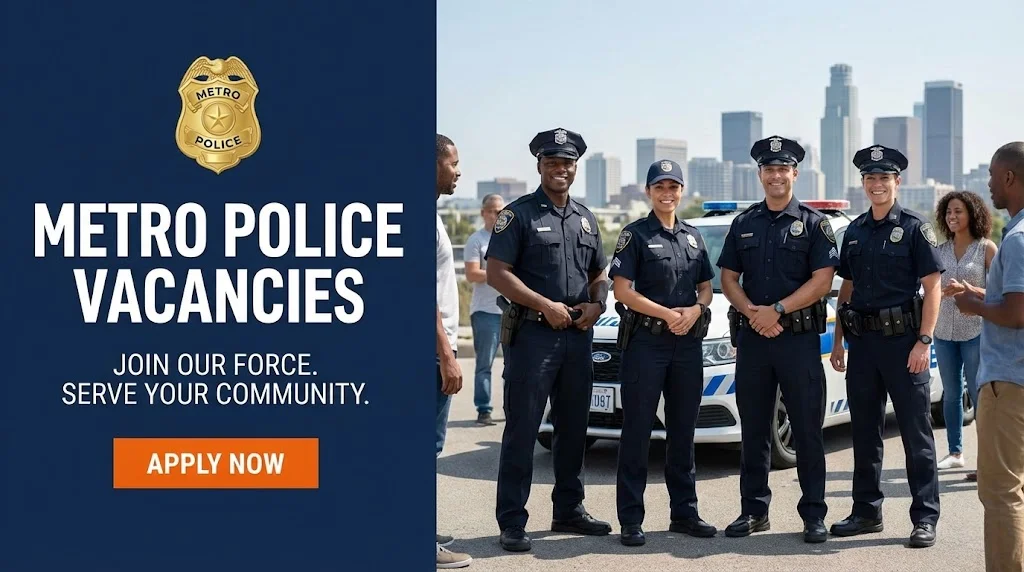
If you have a strong sense of justice and want to protect your local community, becoming a municipal law enforcement officer is a powerful career choice. Every major city in South Africa relies on its local force, making Metro Police Vacancies some of the most highly anticipated public sector job drops of the year.
Unlike the national SAPS (South African Police Service), Metro Police departments operate at the municipal level. They are primarily tasked with enforcing city by-laws, managing localized crime prevention, executing traffic control, and providing visible policing in busy urban centers like Johannesburg, Cape Town, and Tshwane.
A functioning metropolitan police force requires more than just officers on the street. Behind the scenes, these departments employ control room operators to monitor CCTV grids, administrative clerks to process traffic fines, and specialized VIP protection units for the mayor’s office.
Getting accepted into the academy provides incredible long-term stability. Recruits are integrated into the municipal SALGBC salary structure, receiving standard government pension benefits, uniform allowances, and highly structured career progression paths.
Here is a breakdown of what you can expect to earn, the different operational roles within the force, and the exact steps to submit your application without making a disqualifying error.
Our Professional Verdict: Metro Police vs. SAPS?
Our Analysis: Joining the Metro Police often offers a slightly different working dynamic than SAPS. Metro officers usually have a more localized, predictable patrol area and focus heavily on traffic and municipal by-law enforcement rather than long-term, complex criminal detective work. The municipal salary benefits are also often viewed as highly competitive compared to national scales.
Expert Pro Tip: “The Fitness Hurdle.” The biggest mistake applicants make is assuming they can get fit after they apply. The physical assessment (running, push-ups, and obstacle courses) happens almost immediately after the paper shortlisting. If you cannot pass the physical exam on day one, you will be sent home instantly. Start training months before the vacancies open.
Job Overview: Salary & Benefits (2026 Estimates)
| Role | Est. Monthly Salary (ZAR) | Category |
| Superintendent / Commander | R35,000 – R48,000 | Senior Command |
| Inspector | R28,000 – R36,000 | Mid-Management |
| Qualified Metro Police Officer | R22,000 – R29,000 | Active Duty |
| Control Room / CCTV Operator | R16,000 – R22,000 | Technical Support |
| Admin / Fine Processing Clerk | R14,000 – R18,000 | Office / Clerical |
| Trainee Officer (Academy) | R5,500 – R7,500 | Training Stipend |
Available Job Positions (2026 Breakdown)
A metropolitan police department functions as a massive security apparatus. Hiring drives are usually categorized into these three operational areas:
1. Active Duty & Field Operations
- Roles: Metro Police Officers, K9 Unit Handlers, VIP Protection, Traffic Wardens.
- The Job: You are the visible face of the law. You will set up roadblocks, chase stolen vehicles, manage crowd control during protests, and arrest suspects caught committing crimes in your jurisdiction.
- Requirement: Grade 12 (Matric), a valid Code B driver’s license, and successful completion of the grueling 18-to-24-month Metro Police Academy training.
2. Technical & Tactical Support
- Roles: CCTV Surveillance Operators, Radio Dispatchers, Fleet Mechanics.
- The Job: The eyes and ears of the force. You will monitor the city’s camera network, direct patrol cars to active crime scenes via radio, and ensure the police vehicles are mechanically sound.
- Requirement: High computer literacy and the ability to remain calm under extreme pressure for control room staff. Artisans need relevant trade tests.
3. Civilian Administration
- Roles: AARTO Clerks, HR Practitioners, Data Capturers, Receptionists.
- The Job: Processing the paperwork. You will capture traffic infringement fines onto the national system, manage officer leave forms, and handle civilian complaints at the front desk of the precinct.
- Requirement: Grade 12. Prior experience in data entry or public administration is highly favored.
The Reality of Working in Law Enforcement
- Danger and High Stress:
This is not a standard 9-to-5 job. Officers deal with armed suspects, severe trauma at car accidents, and volatile crowds. The psychological toll is significant, and you must possess immense mental resilience.
- Intensive Background Vetting:
The department demands absolute integrity. Before you are even allowed into the physical fitness test, your fingerprints will be run through the SAPS database. Any criminal record—even a minor offense from years ago—will result in immediate rejection. Furthermore, any visible tattoos (neck, face, or hands) are usually strictly prohibited.
- The Grueling Academy Phase:
Getting accepted as a trainee is just the beginning. The Metro Police Academy involves intense physical conditioning, firearm training, and heavy studying of South African law. Failing the academic or shooting exams during your training period will result in dismissal.
Featured “Hot Job”: Metro Police Trainee (Intake)
Major cities periodically announce mass recruitment drives for new trainees to enter the Police Academy. These intakes are highly competitive.
- Estimated Stipend: R5,500 – R7,500 per month (during training).
- Location: Major Metros (Johannesburg, Tshwane, Cape Town, eThekwini).
Requirements:
- Valid Grade 12 (Matric) certificate.
- Valid Code B driving license (Manual).
- No criminal record, physically fit, and a South African citizen between 18 and 35 years old.
How to Apply Correctly? (Multiple Channels)
Municipal law enforcement recruitment is highly rigid. Do not send an informal email or drop a CV at a random police station; follow the official guidelines.
Method 1: The Official Municipal e-Recruitment Portal
Most major metropoles (like Cape Town and Johannesburg) have digitized their hiring processes.
- Step 1: Navigate to the official website of your specific municipality (e.g., Johannesburg or Cape Town).
- Step 2: Register a profile on their e-Services or careers portal.
- Step 3: Wait for the official “Metro Police Trainee Intake” to be announced (usually heavily advertised in national newspapers).
- Step 4: Submit your application digitally, ensuring your online CV matches your actual qualifications. Do not upload fake licenses.
Method 2: The Physical Z83 / Municipal Form (For Smaller Metros)
- Action: For municipalities like Ekurhuleni or Mangaung, paper applications are often still required.
- How: Download the specific municipal application form from their website. Fill it out in black ink, attach a tightly stapled CV, and include certified copies of your ID, Matric, and driver’s license. Hand-deliver it to the specific HR address listed on the advert before the cut-off time.
Method 3: LinkedIn (For Civilian Management Roles)
- Action: Follow your city’s (e.g., Johannesburg or Cape Town) official municipal LinkedIn page.
- Why: While you cannot apply to be a street cop via LinkedIn, the municipal HR teams frequently use the platform to source high-level civilian talent, such as Directors of Public Safety, Fleet Managers, or Senior Legal Advisors for the department.
Thabo Mandla is the lead Career Guide Expert at DurbanTalent.com. With over 10 years of practical experience in South African recruitment, he specializes in connecting professionals with top employers in Aviation, Finance, and Hospitality. Thabo combines his background in Human Resources with direct insights from local hiring managers to provide job seekers with accurate, actionable, and reliable career advice. He is passionate about helping candidates navigate the Durban job market and achieve their professional goals.