
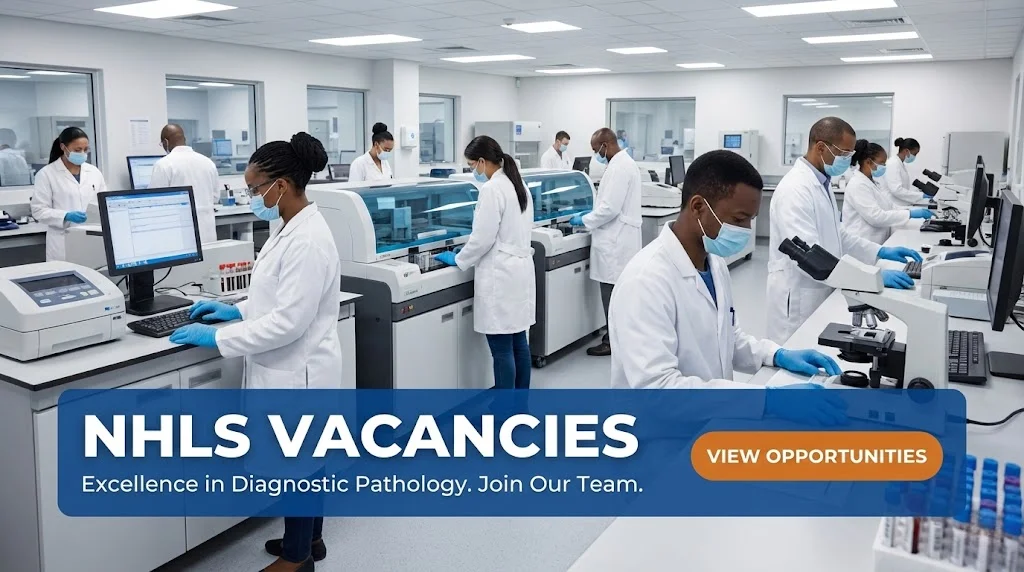
If you want to be part of the critical scientific backbone that supports South Africa’s public healthcare system, applying for the latest NHLS Vacancies is an exceptional career choice. The National Health Laboratory Service (NHLS) is the largest diagnostic pathology service in South Africa.
They provide vital laboratory and public health services to over 80% of the South African population. Every time a state doctor orders a blood test at a provincial hospital, a TB sputum test at a rural clinic, or a forensic analysis, that sample is sent to an NHLS laboratory. Operating a massive network of over 260 laboratories nationwide, their scale of operations is staggering.
Because they process millions of biological samples annually, their recruitment demands are relentless. They are constantly searching for meticulous medical technologists to analyze complex blood cultures, highly trained pathologists to diagnose tissue biopsies, and robust logistics staff to ensure bio-hazardous samples are transported safely from clinics to the labs.
Securing a permanent role within the NHLS means entering a highly stable, state-aligned clinical environment. Employees benefit from competitive OSD (Occupation Specific Dispensation) salary scales, excellent continuous training, state medical aid subsidies, and the profound knowledge that their daily work directly influences patient diagnoses and survival.
Let’s review the realistic earning potential for laboratory and administrative staff, the specific medical science jobs South Africa desperately needs, and the correct, structured steps to navigate their strict digital application portal.
Our Honest Take: NHLS vs. Private Pathology Labs?
Our Analysis: Working for a private pathology lab (like Ampath or Lancet) is highly commercialized; the focus is on rapid turnaround times for paying clients and private doctors. Working at the NHLS is pure public health. The volume of samples you will process daily is significantly higher than in the private sector. You will be exposed to a much wider variety of complex, advanced stage diseases (like drug-resistant TB or rare viral infections) because state hospitals handle the bulk of the country’s severe medical cases. It is a tougher environment, but clinically, it is far more enriching.
Expert Pro Tip: “The HPCSA Keyword.” If you are applying for any clinical or laboratory role (Technologist, Technician, Pathologist), your CV must prominently display your Health Professions Council of South Africa (HPCSA) registration status. Without active, paid-up HPCSA registration in the correct clinical category, the NHLS HR screening system will automatically reject your application.
Job Overview: Salary & Benefits (2026 Estimates)
| Role | Est. Monthly Salary (ZAR) | Category |
| Specialist Pathologist | R90,000 – R130,000+ | Medical Leadership |
| Laboratory Manager | R45,000 – R65,000 | Lab Operations |
| Medical Technologist | R30,000 – R45,000 | Core Diagnostic |
| Medical Technician | R20,000 – R28,000 | Clinical Support |
| Phlebotomist / Sister | R18,000 – R26,000 | Specimen Collection |
| Data Capturer / Admin | R12,000 – R18,000 | Office Support |
Available Job Positions (2026 Breakdown)
Because the NHLS manages the entire diagnostic lifecycle—from drawing the blood to delivering the final medical report—their recruitment circulars target three distinct operational areas:
1. Core Laboratory Diagnostics
- Roles: Medical Technologists (Microbiology, Hematology, Chemical Pathology), Medical Technicians, Specialist Pathologists.
- The Job: Finding the disease. You will load blood samples into massive automated chemistry analyzers, manually stain and review tissue biopsies under microscopes for cancer cells, or isolate and identify complex bacterial cultures.
- Requirements: A National Diploma or Degree in Biomedical Technology. Independent Practice registration with the HPCSA is an absolute legal requirement.
2. Pre-Analytical & Logistics (Field Operations)
- Roles: Phlebotomists, Medical Scientists, Lab Assistants, Specimen Drivers.
- The Job: Getting the sample safely to the lab. You will draw blood directly from patients in state clinics, properly catalog and store incoming bio-hazardous samples in the receiving bay, or drive specialized cooler vehicles to transport specimens across the province.
- Requirements: Phlebotomists require a specific SANC/HPCSA recognized certificate. Drivers need an unendorsed license and dangerous goods training.
3. Quality Assurance & Corporate Administration
- Roles: QA Officers, IT Systems Analysts, Supply Chain Practitioners, HR Officers.
- The Job: Running the massive network. You will conduct strict internal audits to ensure the lab maintains its SANAS accreditation, manage the massive TrakCare IT system that logs patient results, or procure millions of Rands worth of chemical reagents globally.
- Requirements: Relevant BCom, HR, or IT degrees. QA officers require deep knowledge of ISO 15189 laboratory standards.
The Reality of Working in Public Pathology
- High-Volume Pressure:
The NHLS processes an astronomical number of tests daily. If you are a Technologist in a major central lab (like Charlotte Maxeke or Groote Schuur), you are dealing with a relentless conveyer belt of samples. State doctors cannot treat patients without your results, so the pressure to maintain turnaround times (TAT) is intense.
- 24/7 Rotational Shifts:
Disease does not sleep. Major NHLS laboratories operate continuously. Clinical staff are required to work strict rotational shifts, which include deep night shifts, weekends, and public holidays, to ensure emergency departments always have diagnostic support.
- Bio-Hazardous Environments:
You are working with human tissue, blood, and highly infectious diseases (like TB and HIV). Strict adherence to Occupational Health and Safety (OHS) and infection control protocols is a matter of life and death. You will wear extensive Personal Protective Equipment (PPE) for your entire shift.
Featured “Hot Job”: Medical Technologist (Microbiology)
Because infectious diseases remain a massive burden on the public health system, the NHLS is continuously headhunting experienced Medical Technologists specializing in Microbiology.
- Estimated Salary: R30,000 – R45,000 per month (plus state shift allowances).
- Location: Charlotte Maxeke Johannesburg Academic Hospital (Gauteng).
Requirements:
- A National Diploma in Biomedical Technology (or equivalent BHSc in Medical Laboratory Sciences).
- Active, paid-up registration with the HPCSA as a Medical Technologist in the category of Microbiology.
- Minimum 2 to 3 years of post-qualification experience in a high-volume diagnostic laboratory.
- Deep proficiency in operating automated blood culture systems and conducting manual antimicrobial susceptibility testing.
How to Apply Correctly? (Multiple Channels)
As a major state-aligned entity, the NHLS utilizes a highly structured, heavily audited recruitment process to ensure fairness and compliance with clinical standards.
Method 1: The NHLS Digital E-Recruitment System
This is the mandatory and primary route for all professional, administrative, and clinical roles.
- Step 1: Visit the official NHLS website.
- Step 2: Browse the current open vacancies. You can filter by specific laboratory locations or scientific disciplines.
- Step 3: The site utilizes an internal applicant tracking system (often standard Workday or MIE). Register a detailed user profile.
- Step 4: Upload your CV and all certified documents in PDF format.
Crucial: You must attach certified copies of your ID, your academic qualifications, and most importantly, your current HPCSA registration card. If these are missing, the system will discard your application.
Method 2: Student Medical Technician/Technologist Intakes
- Action: Apply for laboratory learnerships.
- Why: The NHLS is the largest training ground for pathologists and technologists in the country. They frequently advertise positions for “Student Medical Technicians,” where they pay you a basic stipend to work in the lab while you complete your required HPCSA practical hours. Look out for these highly competitive intakes early in the academic year.
Method 3: Academic & Professional Networking
- Action: Connect via LinkedIn and university alumni boards.
- Why: For highly specialized roles (like Molecular Biologists or Senior Pathologists), the NHLS Talent Acquisition team frequently headhunts via LinkedIn and through the medical faculties of major universities (like Wits and UCT). Ensure your professional profiles highlight your specific diagnostic specialties.

Thabo Mandla is the lead Career Guide Expert at DurbanTalent.com. With over 10 years of practical experience in South African recruitment, he specializes in connecting professionals with top employers in Aviation, Finance, and Hospitality. Thabo combines his background in Human Resources with direct insights from local hiring managers to provide job seekers with accurate, actionable, and reliable career advice. He is passionate about helping candidates navigate the Durban job market and achieve their professional goals.