
If you are a clinical professional or public health expert driven by the desire to combat severe infectious diseases in vulnerable communities, applying for the latest Right to Care Vacancies is a profoundly impactful career choice. Right to Care is one of South Africa’s largest and most heavily funded Non-Governmental Organizations (NGOs), dedicated to the prevention, treatment, and care of HIV/AIDS, Tuberculosis (TB), and other emerging public health threats.
Headquartered in Centurion but operating massive mobile and stationary clinics across several provinces (including Mpumalanga, Free State, and the Eastern Cape), Right to Care partners directly with the Department of Health and international donors like USAID. They do the heavy lifting in rural areas where state resources are stretched thin.
To maintain their massive clinical footprint, they are constantly recruiting dedicated professional nurses to administer ARVs, highly analytical monitoring and evaluation (M&E) officers to prove program success to international donors, and skilled mobile pharmacy assistants to dispatch chronic medication directly into communities.
Securing a role at Right to Care means entering a highly dynamic, grant-funded NGO environment. Employees benefit from competitive corporate-aligned salaries, flexible working conditions, extensive continuous clinical training, and the immense satisfaction of knowing their daily work directly saves lives on the ground.
Let’s review the realistic earning potential for clinical and support staff, the specific public health jobs South Africa desperately needs right now, and the correct digital steps to submit your CV.
Our Honest Take: Right to Care vs. State Hospitals?
Our Analysis: Working as a nurse in a state hospital means dealing with extreme overcrowding and general trauma. Working for Right to Care is highly specialized. Your entire focus will be on specific public health interventions (mostly HIV/TB and NIMART programs). The facilities (especially the mobile clinics) are often better equipped than rural state clinics because they are backed by massive international donor funds (like PEPFAR). However, job security here is directly tied to grant cycles. If a 5-year USAID grant ends, your specific contract might end with it.
Expert Pro Tip: “The NIMART Keyword.” If you are applying for a Nursing role at this NGO, your CV must scream HIV competence. Explicitly state your NIMART (Nurse-Initiated Management of Anti-Retroviral Treatment) certification and your experience with TIER.Net data capturing. Without NIMART, you cannot prescribe ARVs, making you largely unemployable for their core field operations.
Job Overview: Salary & Benefits (2026 Estimates)
| Role | Est. Monthly Salary (ZAR) | Category |
| Medical Officer (Clinical) | R70,000 – R90,000 | Senior Clinical |
| M&E / Data Manager | R40,000 – R60,000 | Program Impact |
| Professional Nurse (NIMART) | R30,000 – R45,000 | Direct Patient Care |
| Pharmacist Assistant | R15,000 – R22,000 | Dispensary |
| Linkage / Community Worker | R8,000 – R14,000 | Field Support |
| Data Capturer (TIER.Net) | R10,000 – R15,000 | Admin Support |
Available Job Positions (2026 Breakdown)
Because Right to Care manages both direct patient interventions and massive data-driven health programs, their recruitment circulars target three highly distinct operational streams:
1. Direct Clinical Services & Field Work
- Roles: NIMART Nurses, Medical Officers, Enrolled Nurses, Phlebotomists.
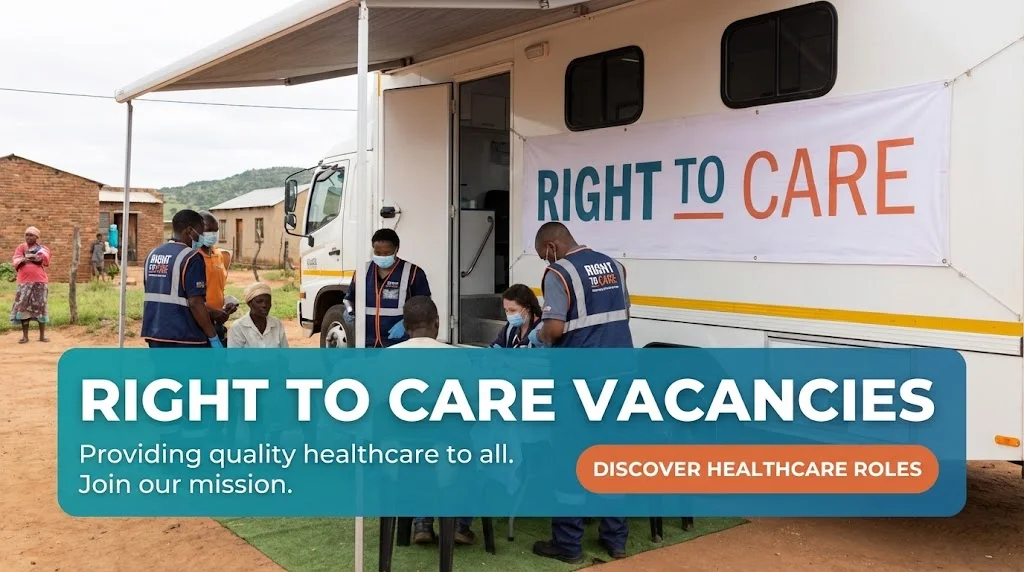
- The Job: Treating the patients. You will travel to deep rural communities in mobile clinics, initiate newly diagnosed patients onto lifelong Anti-Retroviral Therapy (ART), screen for TB co-infections, or provide voluntary medical male circumcision (VMMC) services.
- Requirements: Relevant Medical or Nursing Degrees. Active SANC/HPCSA registration is strictly mandatory. A valid driver’s license is usually required as heavy travel is involved.
2. Data Management, M&E & Research
- Roles: Monitoring & Evaluation (M&E) Officers, Data Capturers, Epidemiologists, Grant Managers.
- The Job: Proving the impact. You will capture thousands of patient files into the national TIER.Net system, design complex data dashboards to track viral load suppression rates across a district, or write highly detailed compliance reports for international donors like the Global Fund.
- Requirements: Degrees in Public Health, Statistics, or Development Studies. Data capturers require extreme typing accuracy and previous TIER.Net experience.
3. Pharmacy Logistics & ATM Dispensaries
- Roles: Pharmacists, Post-Basic Pharmacist Assistants, Logistics Coordinators.
- The Job: Moving the medicine. Right to Care is famous for its “Pharmacy Delivery Units” (PDUs)—basically ATMs for chronic medication. You will manage the secure loading of these machines, ensure strict cold-chain compliance for sensitive drugs, or dispense medication directly to patients.
- Requirements: Active registration with the South African Pharmacy Council (SAPC) is an absolute legal requirement for all dispensary staff.
The Reality of Working in an HIV/TB NGO
- The Emotional Toll of the Field:
Working in community healthcare means dealing directly with systemic poverty, severe illness, and high mortality rates, particularly regarding late-stage HIV or drug-resistant TB. “Compassion fatigue” is very common, and field workers must have strong emotional boundaries.
- Strict Donor Compliance:
Because Right to Care uses money from foreign governments (like the US government via USAID), their administrative and financial auditing is brutal. If you are an M&E officer or a Project Manager, every single cent spent and every patient treated must be meticulously documented.
- The Contractual Nature of NGOs:
Most jobs advertised are linked to specific funding cycles (e.g., a 3-year PEPFAR grant). While Right to Care is excellent at securing continuous funding, you must accept that your employment contract will likely have an exact end date tied to that specific donor grant.
Featured “Hot Job”: NIMART Professional Nurse
To achieve the UNAIDS 95-95-95 targets, Right to Care is continuously deploying highly skilled Professional Nurses into under-resourced districts to initiate and manage HIV treatment.
- Estimated Salary: R30,000 – R45,000 per month (depending on experience).
- Location: Various District Clinics (e.g., Thabo Mofutsanyana, Ehlanzeni).
Requirements:
- A recognized Diploma or Degree in Nursing (Basic R425 qualification).
- Active and current registration with the South African Nursing Council (SANC).
- Certified, proven completion of NIMART (Nurse-Initiated Management of Anti-Retroviral Treatment) training.
- Minimum 2 years of practical experience working in a high-volume HIV/TB or primary healthcare clinic.
- A valid Code 8 driver’s license (frequent travel between rural clinics is required).
How to Apply Correctly? (Multiple Channels)
Right to Care utilizes a modern, centralized digital recruitment system. They rarely accept CVs dropped off at local clinics.
Method 1: The Right to Care E-Recruitment Portal
This is the primary and mandatory route for all clinical, data, and administrative roles.
- Step 1: Visit their official Right to Care careers page.
- Step 2: Browse the current vacancies. They are usually filtered by province and specific donor project.
- Step 3: Click on the specific advert, which will usually direct you to their embedded applicant tracking system (often powered by platforms like Sage or Pnet).
- Step 4: Register a profile and upload your CV as a PDF.
Crucial: If you are applying for a clinical role, your CV must be accompanied by a clear, certified copy of your active SANC, HPCSA, or SAPC registration certificate.
Method 2: NGO Aggregator Boards (Sangonet)
- Action: Monitor dedicated NGO job boards.
- Why: While their own website is best, Right to Care frequently cross-posts their urgent vacancies on major non-profit job boards like NGO Pulse (Sangonet). Setting up job alerts on these platforms ensures you never miss a new project rollout.
Method 3: Internal Referrals (For Field Workers)
- Action: Network with current Linkage Officers.
- Why: If you are applying for grassroots, community-level roles (like Linkage to Care Officers or Lay Counselors), NGO project managers often rely heavily on local community networks. Knowing someone already working on a Right to Care project in your district can get your CV directly into the hands of the hiring manager before it goes online.

Thabo Mandla is the lead Career Guide Expert at DurbanTalent.com. With over 10 years of practical experience in South African recruitment, he specializes in connecting professionals with top employers in Aviation, Finance, and Hospitality. Thabo combines his background in Human Resources with direct insights from local hiring managers to provide job seekers with accurate, actionable, and reliable career advice. He is passionate about helping candidates navigate the Durban job market and achieve their professional goals.